


Promotional Products, Giveaways & Prize Mechanics
Beyond the Giveaway: How Games Make Promotional Products More Interactive
October and November are when fall events, holiday planning, customer appreciation and year-end promotions start converging. Instead of asking only what a brand can give away, ask what it can get people to do.
Giveaways
Prize Mechanics
Interactive Marketing
Fall Events & Halloween
Use games and promotional products as part of seasonal activations, employee gatherings, customer events and fall campaigns.
Customer & Employee Appreciation
Shift the conversation toward useful, entertaining and interactive promotional formats as year-end programs take shape.
Holiday & Retail Momentum
Connect games, giveaways and prize mechanics to holiday-facing promotions, retail environments and end-of-year engagement.
Introduction — A Giveaway Gets Attention; An Experience Creates Interaction
A Giveaway Is the Start, Not Always the Experience
Promotional products are often handed over in a single moment. Interactive products can give the brand something to do before, during and after that handoff.
There is nothing inherently wrong with a conventional giveaway. A useful product can put a logo into someone’s office, vehicle, home, bag or daily routine. But the actual marketing interaction may be over almost as soon as the product changes hands. The attendee receives it, says thank you and moves on.
Games change that sequence. Instead of making the promotional product the end of the interaction, the game can make it the beginning. A person may stop to spin a wheel, take a shot, make a toss, compete against a colleague or try to reach a specific score. The promotional product is no longer simply something being distributed. It is part of an experience the audience can actively participate in.
That distinction becomes especially useful in October and November. Fall events, Halloween gatherings, customer appreciation programs, employee celebrations, holiday planning and retail promotions all create opportunities where marketers are already looking for something more engaging than another table full of giveaways.
For agencies sourcing from promotional product wholesalers or comparing promotional wholesale suppliers, the useful question is not simply which product has the right logo placement. It is whether the product gives the campaign a reason to create an interaction.

When the Promotional Product Becomes the Activity
01 / What Is a Promo Game?
Define the Category: Product + Play
A promo game is a game or game-related product that carries promotional branding and is used as part of a marketing, event, gifting or engagement program.
That definition matters because a promo game sits between a traditional promotional product and an event activity. It can be a full-size game positioned inside an event environment, a compact tabletop game used at a booth or office, a prize-oriented game built around a particular mechanic or a recreational item that becomes more meaningful when it is branded.
The appeal is the combination. The product supplies the branded object. The game supplies the action. Together, they give people something to see, touch, try or compete with.
The terminology can vary, but the underlying idea remains straightforward. promo game and promo games describe a category in which the promotional object is tied directly to gameplay or participation.
That makes promo games particularly adaptable to October and November campaigns. A fall event can use an interactive game as a central activity. A holiday program can use a compact game as part of a gift or recognition package. A trade show can use a game to create a visual focal point. A retail promotion can build a simple challenge around a promotional offer.
02 / The Difference Between a Prize and a Game
A Prize Is Received. A Game Is Experienced.
The distinction between a prize and a game is simple, but it changes how a promotion is designed.
A prize is something a participant receives. It can be desirable, useful, entertaining or valuable to the recipient, but the prize itself does not necessarily create a reason to spend time with the brand.
A game is different because it creates an action. Someone has to spin, toss, shoot, putt, stack, match or compete. That action creates a moment around the brand. Other people can watch it. Staff can talk to participants while it happens. A participant may take another turn because they want to improve their result.
Combining the two can make the promotion more complete. The game creates the interaction, while the prize gives the interaction an additional purpose. The participant is not simply being handed something. They are taking part in an experience that determines, reveals or accompanies the reward.
That is one reason wholesale giveaway items can be evaluated differently when they are connected to gameplay. The item becomes part of a larger sequence instead of being the entire promotion.
The same thinking applies to promotional games. The question becomes less about how to distribute something and more about how to build an interaction around it.
A prize is the outcome. The game is the moment that gets people to the outcome.

Turn the Giveaway Into a Moment
Why October and November Matter
Q4 Gives Promotional Games More Places to Work
October and November sit at a useful point in the marketing calendar. Fall events are still active, while holiday and year-end programs are becoming more prominent. That creates a wide range of places where an interactive promotional product can fit.
Fall Festivals & Halloween Events
Seasonal gatherings can use games to create activity around food, beverages, entertainment and branded spaces. The format can be playful without requiring the entire event to revolve around a giveaway.
Customer Appreciation
As the year approaches its close, brands can shift attention toward customer events, appreciation programs and memorable promotional experiences rather than one-off handouts.
Holiday & Retail Promotions
Interactive products can add activity to holiday-facing environments, promotional campaigns and retail experiences where brands are competing for attention during a crowded time of year.

Put the Game Where the Audience Already Is
03 / Where Games Fit Into Promotional Campaigns
From Trade Shows to Year-End Events
The best promotional game is not necessarily the biggest one. It is the one that fits the audience, environment and desired interaction.
Trade shows. A game can create a physical point of activity within a booth. Instead of relying entirely on signage to communicate that a company is present, the activity gives attendees something immediate to notice and potentially participate in.
Brand activations. Interactive products can help define an activation zone and provide a clear reason for attendees to enter it. A simple challenge can create a natural transition from observing the brand to interacting with it.
Customer events. Customer appreciation events, receptions and gatherings can use games as shared activities rather than individual giveaways. The game becomes something people experience together, while the branding remains part of the environment.
Employee programs. Games can also fit employee gatherings, recognition programs and internal events where the goal is to create a more active experience. The same basic mechanic can be competitive, collaborative or simply recreational depending on the event.
Festivals and public-facing events. Outdoor and community environments provide room for larger activities and more visible gameplay. The game can become part of the overall event atmosphere rather than being restricted to a small promotional table.
Explore more ideas around promotion games and the broader category of a promotion game when building the activity layer of a campaign.
04 / Prize Mechanics That Encourage Participation
Give People a Reason to Take a Turn
The prize mechanic determines what happens after someone decides to play.
There does not have to be one universal structure. The right mechanic depends on the campaign and the kind of interaction the brand wants to create. A simple promotion might use a random prize assignment. A competitive event might reward a score or performance. A retail activation might connect the game to a specific promotional action.
The important part is clarity. Participants should understand what they are being asked to do and what happens as a result. When the mechanic is easy to explain, the game can stay focused on the experience instead of turning into a complicated process.
A participant spins the wheel to reveal a result, prize or promotional outcome. The reveal becomes part of the experience rather than something that happens separately from it.
A shot, toss, putt or other measurable action can determine the outcome. The participant knows that what they do during the game matters to the result.
Short challenges can create an easy format for head-to-head play, team interaction or repeat attempts without requiring a long event schedule.
A game or participation event can establish eligibility for a drawing, allowing the activity to happen first and the prize selection afterward.
A promotion can connect participation to a defined action, such as completing a challenge or taking part in a branded activity.
Some games can make the prize part of the gameplay itself, creating a moment of discovery as the participant advances through the activity.
For visual, high-energy mechanics, explore prize wheel ideas or review spin the wheel prizes ideas.
Why Prize Mechanics Work
The Reveal Is Part of the Marketing Moment
A prize does not have to be immediately visible to be motivating. Sometimes the anticipation of finding out what happens next is what creates the moment.
That is one reason prize wheels remain such a recognizable promotional game format. The participant physically initiates the outcome. The motion is visible to everyone nearby, the result is easy to understand and the reward can be built directly into the experience.
The mechanic can also be adapted to different kinds of campaigns. A wheel might reveal a prize, a promotional message or another defined outcome. The important element is that the participant does something first and gets the result through the game.
This makes the prize wheel a useful example of the larger principle behind interactive promotional products. The product is not merely carrying the brand. It is helping stage the interaction.
When the action and the reward are connected, the audience has a reason to experience the promotional product instead of simply receiving it.

Make the Reveal Part of the Experience
05 / Promotional Games vs. Conventional Promotional Products
The Difference Is the Interaction
Traditional promotional products and promotional games can both have a place in a campaign. The distinction is what happens around the product.
Conventional Promotional Product
- Often distributed as a finished giveaway.
- The recipient receives the item directly.
- The interaction can be brief.
- The product carries the branding after the handoff.
- Useful when the campaign centers on distribution or gifting.
Promotional Game
- Introduces an action before, during or around the giveaway.
- The participant becomes part of the activity.
- The interaction can include spectators and additional participants.
- The gameplay itself can carry the branding.
- Useful when the campaign centers on participation and experience.
The two approaches do not have to compete. A campaign can distribute traditional products while using a game as the activity that attracts attention. The game can also lead into a giveaway, making the promotional item part of a larger experience.
That is the practical reason to think about promotional games as a category rather than treating them simply as another type of swag. They change what the audience is asked to do.

Match the Product to the Moment
Designing October and November Promotions
Match the Game to the Moment
Seasonality should influence the experience without forcing every promotion to become a holiday-themed promotion.
October can support fall festivals, Halloween events, brewery and hospitality activations, trade shows and employee gatherings. In those environments, the game can be playful and visually distinctive while still carrying the brand identity of the campaign.
November introduces another set of opportunities. Customer appreciation, employee recognition, year-end gatherings and early holiday activity can all benefit from promotional products that feel more substantial than a disposable handout.
For client-facing programs, an interactive game can also become a shared activity. That makes the branded product relevant to the event itself rather than simply being something attendees are expected to take home.
The key is to start with the event moment and work backward. Are people arriving? Waiting? Networking? Shopping? Celebrating? Competing? Gathering around food and beverages? The answer determines whether the best format is a tabletop game, a quick prize mechanic, a larger game or a product that becomes the giveaway itself.
That approach keeps the promotional product tied to the event rather than making the event feel like an excuse to distribute products.
Use familiar games to create activity around outdoor and social environments.
Use playful game mechanics where the seasonal atmosphere already supports entertainment and participation.
Choose experiences that make the gathering itself part of the promotional program.
Use games and useful promotional products as alternatives or complements to conventional gifting.
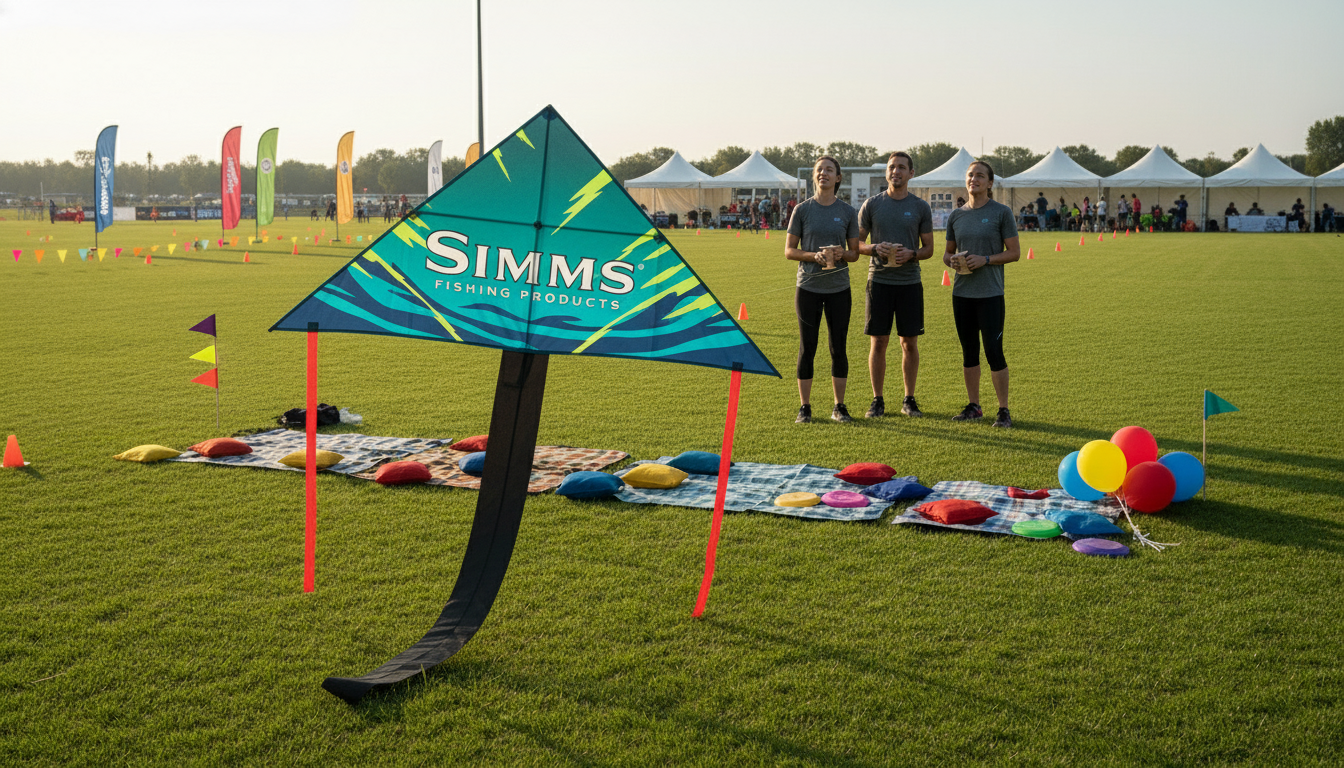
06 / Kites and Other Unconventional Promotional Formats
Not Every Promotional Product Has to Stay on the Table
One of the most useful ways to rethink promotional products is to look beyond familiar categories. An unusual format can change the physical reach of a campaign and give the audience another reason to interact with the branded product.
Kites are a good example. They are not simply another item sitting on a giveaway table. They belong to an activity. Someone has to take the kite outside, launch it and interact with it. That creates a different relationship between the recipient and the branded object.
That makes promotional kites an interesting format for festivals, outdoor campaigns and event environments where the product can become part of the activity itself.
The broader lesson is not that every campaign needs a kite. It is that promotional products become more interesting when the product has a reason to be used. A game, recreational item or other unconventional format can carry the brand while giving the audience an action that goes beyond receiving the product.
The most distinctive promotional format may be the one that changes what people do with the product after they receive it.
The Interactive Campaign Model
Build a Sequence Around the Product
A promotional game can be thought of as a simple sequence rather than a single object.
The game or unusual promotional format gives people something visually distinct to notice within the environment.
The activity creates a reason to move closer and understand what is happening.
The attendee takes an action rather than simply receiving information or a product.
The game creates room for conversation, competition, observation and additional turns.
The giveaway or promotional reward becomes part of what the participant takes from the experience.
The branded game and the interaction become connected in the participant’s experience of the event.
The promotional product does not have to perform every job by itself. The game can attract attention, the interaction can create the conversation and the giveaway can complete the experience.
07 / Explore the Branded Games Category
Promotional Games Are Part of a Larger Branded Game Category
Promotional games are not limited to prize wheels or one particular type of giveaway. The broader category includes games that can be used for trade shows, employee programs, customer events, outdoor activations, retail environments, gifting and other promotional applications.
That makes the category useful when a campaign starts with an audience or event rather than with a specific product. Instead of asking which item should carry a logo, the planning process can begin with the desired interaction and then identify the game format that fits.
Use interactive formats to create activity within compact exhibit environments and give attendees a reason to engage.
Connect gameplay to prizes, rewards or branded products so the giveaway becomes part of a larger interaction.
Move the experience into festivals, hospitality spaces, customer events and other open environments.
Explore the broader branded games category to see how different formats can support different types of promotional experiences.
Conclusion — Move From “What Can We Give?” to “What Can We Get People to Do?”
Make the Promotional Product Part of the Interaction
Promotional products become more interesting when the audience has a reason to interact with them. A giveaway can deliver a branded object. A game can create the moment around that object.
That distinction is particularly useful during the October and November planning window. Fall events, Halloween gatherings, customer appreciation programs, employee recognition, holiday campaigns and retail promotions all create opportunities for brands to move beyond passive distribution.
The strongest approach does not necessarily mean replacing every conventional promotional product with a game. It means recognizing when interaction would add something to the campaign. A prize wheel can create anticipation. A skill-based challenge can create competition. A tabletop game can provide an easy conversation starter. An outdoor game can turn open space into an activity area. An unusual product such as a promotional kite can make the giveaway itself part of the activity.
The common thread is participation.
Instead of asking only, “What can we give away?” start asking, “What can we get people to do?” That question changes the way the promotional product is selected, the way the space is planned and the way the audience encounters the brand.
Use a recognizable game or distinctive promotional format to create a visible point of activity.
Make the interaction simple enough to understand and engaging enough to participate in.
Let the prize or promotional product become part of the experience instead of the entire experience.
That is the difference between handing someone a promotional product and building a promotional experience around one.