


From Spectator to Participant: Designing Sports Brand Experiences That Get Fans Involved
Sports already gives marketers one of the most powerful ingredients in experiential marketing: an audience that is emotionally invested in what is happening.
Soccer
Basketball
Tailgating
Brand Participation
Give Fans Something to Do
Fans arrive ready to watch competition, follow their team, celebrate big moments, and talk with the people around them. The opportunity for a brand is to give that audience something else to do.
That can be as simple as a skill challenge, a head-to-head competition, a branded game, or an activity that reflects the sport itself.
The important distinction is that the promotional element becomes part of the experience rather than something positioned beside it.
See the brand → understand the activity → participate → interact with others → associate the experience with the brand.
Promotional Products vs. Promotional Experiences
Promotional products are often designed to be seen, carried, worn, displayed, or taken home. Promotional experiences ask the audience to do something.
That difference matters in a sports environment.
Sports fans are already accustomed to participation. They understand competition. They understand skill. They understand winning and losing. They are surrounded by rituals that involve cheering, playing, comparing scores, and challenging friends.
A promotional activity can tap directly into those behaviors.
Instead of handing someone another branded object, a brand can give them a reason to use one.
Instead of putting a sponsor logo beside the action, the sponsor can become part of the action.
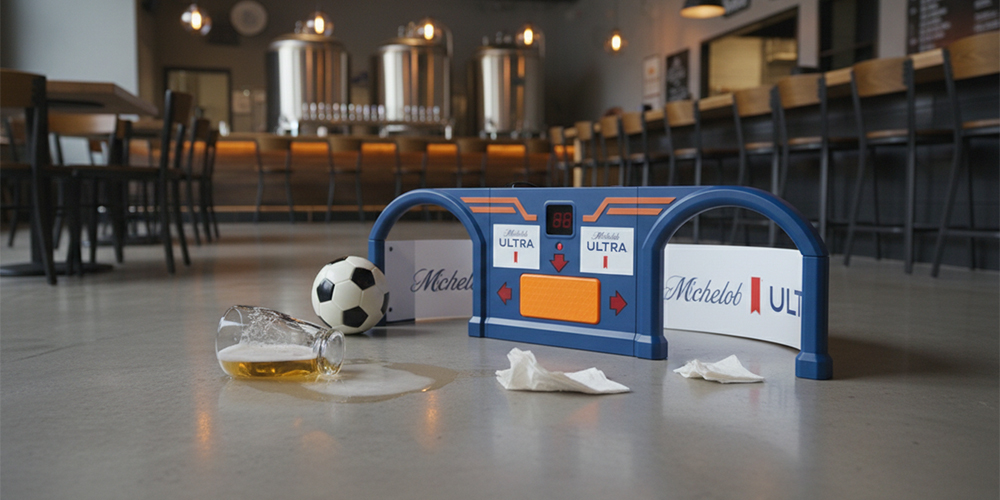
The sponsor becomes part of the action.
That is where physical games and skill-based activities can fit naturally into sports marketing.
The activity does not have to replace the event. It simply gives fans another way to engage with the same competitive energy.
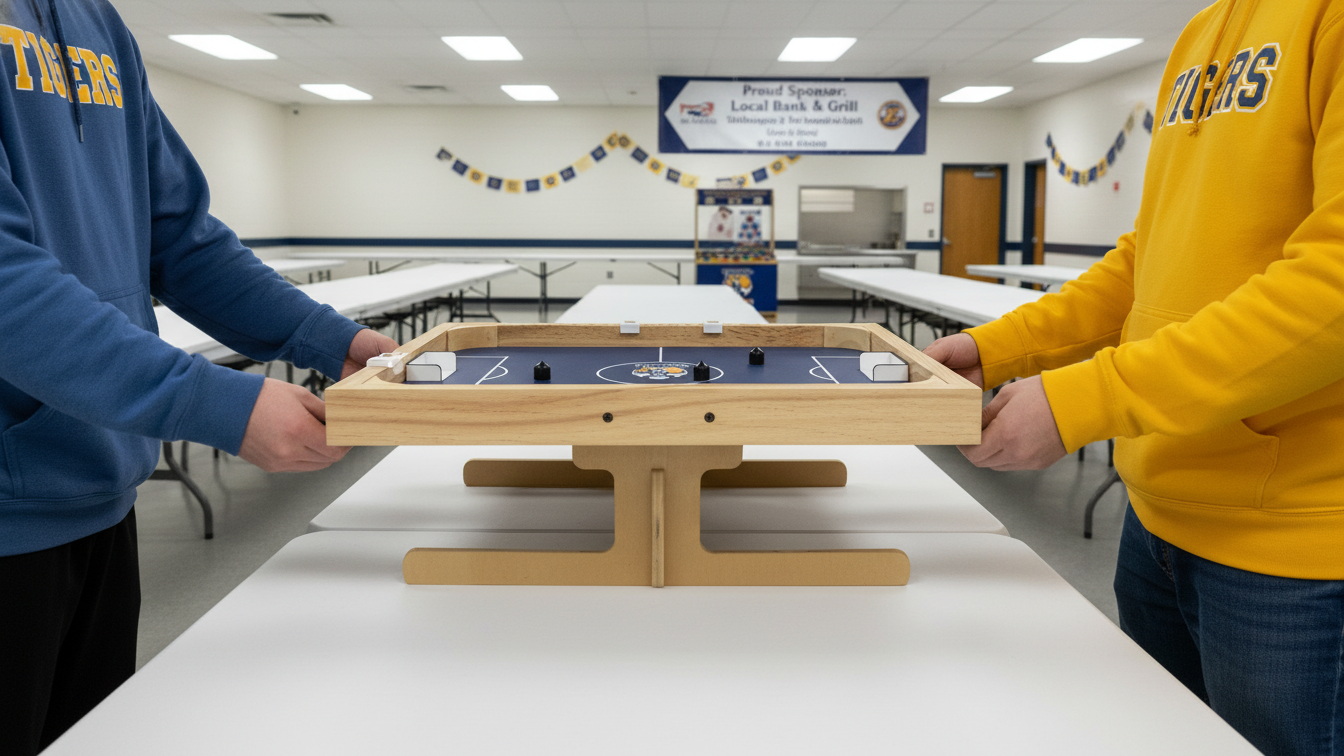
Participation can live around the competition.
This is particularly valuable in the spaces surrounding the main event.
A concourse, fan zone, sponsor area, hospitality space, campus event, sports bar, community tournament, or tailgate can all create opportunities for interaction before, during, or after the actual competition.
The more naturally the activity fits the setting, the less it feels like an interruption.
Build Sports Promotions Around Interaction
The best sports experiences give fans an immediate reason to participate.
That reason might be competition.
It might be curiosity.
It might be a challenge from a friend.
It might simply be the desire to try something that looks fun.
That is why sports promotional items can be more strategically useful when they are considered as part of a broader fan-engagement environment rather than as a list of merchandise.
The interaction should be immediately understandable. A participant should not need a detailed explanation to determine whether the activity is worth trying.
Competition gives the activity a natural structure. Two people can challenge each other. Friends can compare scores. A group can take turns.
Not everyone has to participate simultaneously. A close competition can draw a small crowd. A successful attempt can encourage someone else to try.
The physical experience becomes a branded touchpoint across equipment, targets, boards, signs, score elements, or the surrounding environment.
A strong sports-oriented activity usually has several things working at once.
It gives fans something to do.
It creates competition.
It creates spectators.
It keeps the sponsor visible.
The result is that the activity can generate its own audience.
That gives the sponsor a role in the interaction rather than limiting it to logo placement.
Soccer Activations: Put the Sponsorship Into the Play
Soccer environments are naturally suited to participation.
The sport is recognizable from a distance, the basic mechanics are familiar, and fans already understand skill-based challenges.
That creates opportunities for brands to build an activation around the behavior of the sport rather than simply placing their identity next to it.
A soccer-focused activity can give fans a chance to test accuracy, control, timing, or competitive skill.
It can work as a quick challenge for one person or become a head-to-head activity between friends.
The key is to connect the sponsorship to something the fan actually does.
That makes soccer activations especially interesting for brands looking to create interaction around matches and soccer-related events.
The activity becomes the branded interaction.
The activity can draw directly from the sport.
A recognizable objective makes participation immediate.
Head-to-head mechanics can create instant energy.
The experience can reflect the event and audience.
The activity should feel native to the occasion.
The sponsor remains part of the physical experience.
The audience has something tangible to do.
The goal is to isolate a recognizable part of the sport and turn it into an accessible interaction.
A fan may not have time for a full game.
They may have time for one challenge.
That is enough to create a branded moment.
Brand → activity → participation → memory.
Turn sponsorship into participation
Traditional sponsorship can make a brand highly visible.
Experiential sponsorship can make the brand part of something the fan actively remembers doing.
That distinction is powerful.
Instead of:
Brand logo → fan sees it
You create:
Brand → activity → participation → memory
The sponsor is no longer just part of the signage package.
It becomes part of the fan experience.
Basketball as a Brand Activation
Basketball has an equally strong advantage for experiential marketing: the action is immediately recognizable.
A hoop tells people what to do.
A ball tells people what to use.
A target creates a challenge.
The experience can often be understood without a long explanation.
That makes a basketball shooting activity particularly effective for fast-moving environments where marketers need people to decide quickly whether they want to participate.
A custom basketball hoop can illustrate an important experiential principle: the promotional object does not have to sit beside the activity.
The product can become the activity.
That changes the role of branding.

The promotional object becomes the activity.
The branded physical object remains central to the interaction.
The brand is present in the action rather than beside it.
The equipment remains part of the visual experience.
Participation can naturally create spectators.
The activity becomes something the audience experienced rather than simply something they saw.
Keep the Mechanics Simple
Basketball activations do not need elaborate rules.
The exact mechanic matters less than the experience around it.
The participant should understand the objective quickly.
The activity should move people through efficiently.
And the branding should remain visible throughout the interaction.
That combination allows a simple shooting activity to function as entertainment, competition, and brand exposure at the same time.
Tailgates Are Promotional Environments
Tailgating has a built-in advantage for marketers: people are already there to socialize.
The event begins before the event.
Fans gather.
Friends arrive together.
Food and drinks come out.
People talk about the game.
Music plays.
And there is usually time to fill.
That makes the tailgate a natural environment for participation.
A branded activity can give people a central point around which to gather without competing directly with the main sporting event.
Instead of asking fans to stop what they are doing, the activity becomes something they do while they are already socializing.
That is why tailgate promotional items can be especially useful when they are selected for interaction as well as visibility.

Turn the tailgate into a gathering point.
A strong tailgate activity can function as a social anchor.
One person starts playing.
Friends gather around.
Someone keeps score.
Another person challenges the winner.
Someone standing nearby decides to try.

The physical activity carries the brand across the environment.
Suddenly the branded object has created a small community around itself.
That is much more dynamic than a promotional item sitting on a table.
Make the brand visible before the venue
Tailgates also create a valuable branding window.
The brand can reach fans before they enter the stadium, arena, or event itself.
That can make the activation feel like part of the day rather than part of a formal sponsorship package.
The physical activity can carry the brand across the environment while giving fans something entertaining to do.
Make Sports Promotions Feel Like the Event
The most effective sports experiences do not feel like generic marketing exercises.
They feel connected to the reason people are there.
That means the activity should reflect the sport, the audience, and the surrounding environment.
A soccer event should feel different from a basketball event.
A basketball experience should speak the language of basketball.
A tailgate should feel different from a formal hospitality activation.
A soccer event should feel different from a basketball event.
A tailgate should feel different from a formal hospitality activation.
A youth tournament should feel different from a professional fan zone.
The underlying principles can remain the same, but the physical execution should belong to the occasion.
Relevance makes participation easier
People should understand why the activity exists.
If the environment is built around soccer, a soccer-related challenge feels intuitive.
If the event centers on basketball, a shooting challenge makes sense.
If fans are gathered around a tailgate, a social competitive game fits naturally.
The activity should feel like an extension of the event rather than something imported into it.
The activity should belong to the occasion.
The brand does not need to appear in exactly the same way everywhere.
Instead, think about several connected touchpoints.
The equipment can carry the identity.
The surrounding signage can reinforce it.
The score or challenge can reference it.
The physical environment can use consistent colors and graphics.
The participant can interact with the branded object directly.
That creates a more complete experience than simply attaching a logo to a nearby sign.
Think Beyond One Product
A single promotional object can be useful. A coordinated experience can be more powerful.
The game can become the centerpiece of the activation.
For example, a branded game can become the centerpiece of a larger sports activation that includes signage, environmental branding, seating, sponsor messaging, and additional activities.
That approach creates more opportunities for people to encounter the brand without turning the space into a wall of advertising.
This is where interactive marketing games can help frame the broader strategy.
The game is not simply a giveaway.
It is part of the interaction.
The interaction is not simply entertainment.
It is part of the brand experience.
And the brand experience does not have to end when the participant finishes playing.
The activity can continue to generate visibility through spectators, repeat attempts, social interactions, photography, and the physical presence of the branded equipment.
Branded Cornhole and the Power of Familiar Competition
Some activities work because everyone already understands them.
Cornhole is a useful example.
The equipment is recognizable.
Two people can play.
A larger group can rotate in.
Spectators can easily understand what is happening.
Branded cornhole can therefore work as a flexible sports-environment activity even when cornhole itself is not the sport being celebrated.
The important point is not that every sports activation needs to use the same game.
It is that familiar competition gives people an immediate reason to participate.
The Sports Activation Checklist
Before selecting the physical activity, think through the experience from the fan’s perspective.
Does the activity naturally connect to the sport, team, event, or audience?
Can people recognize that something is happening before they reach the activation?
Can a fan understand the activity and begin quickly?
Can it support one person, two people, or a small group without creating unnecessary downtime?
Does the brand remain visible throughout the interaction rather than appearing only on nearby signage?
Can the experience be moved, stored, transported, and used in the environments where the activation actually takes place?
Those questions can prevent a common mistake in sports marketing: choosing the promotional object first and figuring out the experience afterward.
Start with the fan.
Then design the interaction.
Then determine which physical elements can make that interaction happen.
The Goal Is More Than Fan Attention
Sports marketers do not have to manufacture excitement from scratch.
The excitement is already there.
Fans care about the competition.
They identify with teams.
They gather with friends.
They watch skilled performances.
They understand challenges.
The opportunity is to connect the brand to those existing behaviors.
That is the shift from spectator to participant.
And when the activity fits the sport, the environment, and the brand, the promotion can feel less like advertising and more like part of the event itself.